 Isaiminia World Breaking News & Top Stories
Key Takeaways
- Practice with one clear priority instead of collecting several swing thoughts.
- Combine focused repetition with changing targets, clubs, and shot demands.
- Give short-game drills a score, target, or consequence.
- Use a consistent pre-shot routine to carry preparation from the range to the course.
- Adapt practice to Florida conditions, including wind, heat, soft turf, and afternoon weather.
Florida golfers can practice nearly year-round, but regular access to a range does not automatically make scoring easier on the course. A purposeful routine helps bridge that gap by connecting swing work to target selection, uneven lies, wind, firm turf, and the decisions that arise during a round. Players looking for structured guidance can explore golf schools in Florida while building a practice plan that fits their current game.
The goal is not to hit the largest bucket possible. It is to make each ball serve a purpose. Whether you play public courses, resort layouts, or your local municipal track, better practice can help turn a good range session into more confident shots when the score matters.
Why Range Success Does Not Always Reach the Course
A driving range usually offers a level stance, a predictable ball lie, and another chance immediately after a poor shot. A Florida course asks for something different. You may face a sidehill lie, a crosswind, a carry over water, a sandy waste area, or a shot from damp grass after an overnight shower. The range is valuable, but it does not automatically teach club selection or commitment.
For example, hitting several solid 7-irons in a row can build rhythm. On the course, that same 7-iron might follow a driver pushed into light rough, with trouble short and a breeze moving across the green. Practice should prepare you to make that decision, not merely repeat the motion.
Set One Clear Goal Before Practice
Arrive with one main objective. It might be cleaner contact with fairway woods, a more reliable start line with irons, wedge distance control, or better putting pace. One goal gives the session a direction and makes it easier to recognize improvement.
Useful Practice Goals
- Start approach shots closer to the intended target line.
- Improve strike quality with a hybrid or fairway wood.
- Learn dependable carry distances for partial wedges.
- Reduce three-putts by improving long-putt speed.
- Choose safer targets around water and bunkers.
Build a Balanced Practice Session
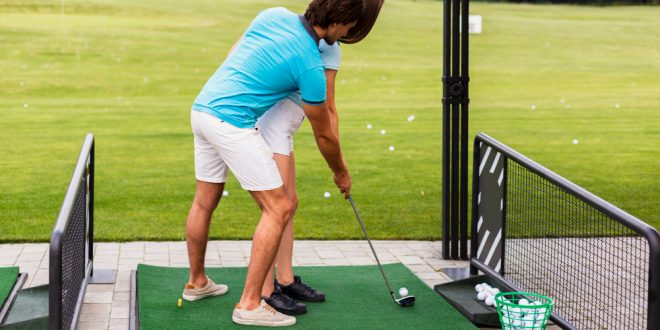
A 60-minute session can cover more than full swings without becoming rushed. Begin with easy chips, short pitches, and half-swings. Then spend 15 minutes on your main technical goal. Use the next 15 minutes to change clubs and targets. Reserve time for putting or greenside shots, then finish with a scored challenge.
Photorealistic wide establishing shot of a golfer practicing at a Florida golf driving range, with multiple target greens, palm trees, lush fairways, scattered practice stations, and a broad sky showing the warm outdoor setting; the golfer should appear small within the expansive range to convey context, scale, and purposeful practice.
In Florida, plan around the weather as carefully as the clock. Afternoon thunderstorms can develop quickly, and the National Weather Service advises moving indoors when thunder is heard because lightning can strike even when a storm is not directly overhead. Ending practice early is always better than trying to squeeze in a final bucket.
Use Block Practice for Swing Changes
Block practice means repeating a similar shot for a short stretch. You might hit eight pitching wedges toward one target while concentrating on ball position or finish balance. This is useful when you are testing a grip adjustment, setup change, or new feel because repeated attempts make patterns easier to notice.
Do not let block practice consume the entire session. Golf rarely gives you the same club, lie, and distance twice in a row. Use repetition to understand a change, then test it in a more realistic format.
Switch to Random Practice
Random practice requires a fresh decision before every shot. Change the club, target, distance, trajectory, or intended shape. This may feel less smooth than striking ten identical balls, but it better resembles the sequence of a round.
Random Practice Ideas
- Hit driver, mid-iron, wedge, and fairway wood in rotation.
- Choose a new target after every ball.
- Alternate full swings with three-quarter and half swings.
- Play an imaginary six-hole loop, using only shots you would reasonably choose on the course.
- Complete your full pre-shot routine before each ball.
Add Pressure to Short-Game Work
Short-game practice becomes more useful when every shot has a landing area and a standard for success. Pick a spot on the green for a chip to land, then judge whether it finishes inside a chosen circle around the hole. For putting, use a distance-control ladder with putts of increasing length instead of rolling every ball from one location.
Try a five-ball challenge from five different lies. Award one point for each chip or pitch that finishes within six feet. Record the result, change the lies next time, and aim to improve the score rather than simply hitting more shots.
Practice Course Decisions, Not Just Swings
Good practice includes thinking like a player on the course. Identify the wide side of a fairway. Pick the safest side of a green. Decide where a reasonable miss can leave a manageable next shot. On Florida courses, this often means respecting water, avoiding a short-sided miss near a bunker, and choosing a target that allows for wind.
When using a grass practice tee, protect the facility for other players by creating a narrow line of divots instead of scattering them across the hitting area. The USGA explains that linear divot patterns help grass recover more effectively, which is especially considerate at busy practice facilities.
Create a Repeatable Pre-Shot Routine
Keep your routine brief. Choose the target from behind the ball, picture the flight, make one rehearsal motion if needed, set the clubface, build the stance, take a final look, and swing. The routine should organize the shot, not introduce a long list of mechanical thoughts.
Track Progress Without Overcomplicating It
A phone note or small notebook is enough. Record the session goal, the most common miss, a short-game score, and one point to carry into the next round. Review several sessions before deciding whether a change is helping. One poor practice day is information, not a final verdict.
Build a Weekly Florida Golf Practice Plan
- Day One, full swing: Use block practice for one contact or technique priority.
- Day Two, short game: Practice chips, pitches, bunker shots, and pace putting with scoring games.
- Day Three, random practice: Change clubs, targets, trajectories, and distances after each shot.
- Day Four, on-course transfer: During a round, focus on conservative targets, your routine, and smart misses.
Conclusion
Better golf comes from practicing with purpose, not simply hitting more balls. Set one clear goal, balance swing work with short-game drills, simulate real course decisions, and build a repeatable pre-shot routine. By tracking progress and adapting to Florida’s changing conditions, you can turn every practice session into a stronger performance when it matters most—one confident shot at a time.