 Isaiminia World Breaking News & Top Stories
Every solar pumping configuration starts with a few figures on the pump motor’s nameplate: rated power, voltage, phase count and current. From those numbers follow the drive model, the array size and the string layout, and an error at the first step carries through every later choice.
A solar MPPT inverter is only one of three items that are often bought separately, alongside the pump and the panels, and the performance of solar inverter solutions for water supply comes from sizing the three against each other.
Reading the Pump Nameplate and the Site
The motor nameplate fixes the output side. A three-phase 220V motor and a three-phase 380V motor need different drive configurations, and the rated current sets the minimum drive size. Site data fixes the hydraulic side: total head, required daily volume, well yield and pipe length determine the pump’s operating point and how many hours of pumping the system needs.
The solar pump VFD sits between these two sides. Its output must match the motor exactly, while its input range must suit an array that will be designed around the power the pump needs. Cable length between drive and pump belongs to the output side as well, because voltage drop over a long run reduces the voltage the motor actually receives.
Building the Array Within the Voltage Window
Array design revolves around voltage. Panels are connected in series strings until the string voltage falls inside the drive’s recommended open-circuit range, and strings are connected in parallel to add current.
Open-circuit voltage rises as panel temperature falls, so a string that sits comfortably inside the window on a warm afternoon can approach the upper limit on a cold, bright morning, and designers check the coldest expected condition before fixing the number of panels per string.
Current is the second limit. The drive’s maximum DC input current caps how many parallel strings it can accept, and the recommended array power is usually set somewhat above the pump rating to keep the pump running for more hours of the day.
Tracking has the most room when the solar MPPT inverter receives a string voltage near the middle of its window and a current within its rating, the condition a well-configured solar pump VFD aims for.
Single-Phase and Three-Phase Configurations Compared
The PV150A from FRECON covers both supply situations within one series. Its 2S configuration accepts single-phase 220V AC input and delivers three-phase 220V AC output, with a recommended PV open-circuit-voltage range of 360–430V.
Four models are matched to 0.4, 0.75, 1.5 and 2.2kW pumps, with recommended solar powers of 0.6, 1.0, 2.0 and 2.9kW and rated output currents of 2.5, 4.2, 7.5 and 9.5A, and each has a maximum DC input current of 10.6A.
Three-phase 380V motors are served by the 4T configuration, which takes 230–800V DC or three-phase 380V AC at its input and works with a recommended open-circuit range of 600–750V. Here the pump selections are 0.75, 1.5 and 2.2kW, paired with 1.0, 2.0 and 2.9kW of recommended solar power; rated output currents are 2.5, 4.2 and 5.5A, and the maximum DC input current again stays at 10.6A.
The higher voltage window of the 4T versions allows longer strings, while the 2S versions suit sites where the backup supply is single-phase 220V or the motor is a 220V type. In either case the solar pump VFD is chosen by the motor’s voltage first and its power second.
Backup Supplies, Water Sensors and Long Cables
A complete configuration includes more than the drive and the array. FRECON’s system arrangement for the PV150A combines solar panels, the inverter, an AC backup supply, the pump, a water tank and water sensors, and the drive switches automatically between DC and AC sources, provides dry-run protection and controls tank water level.
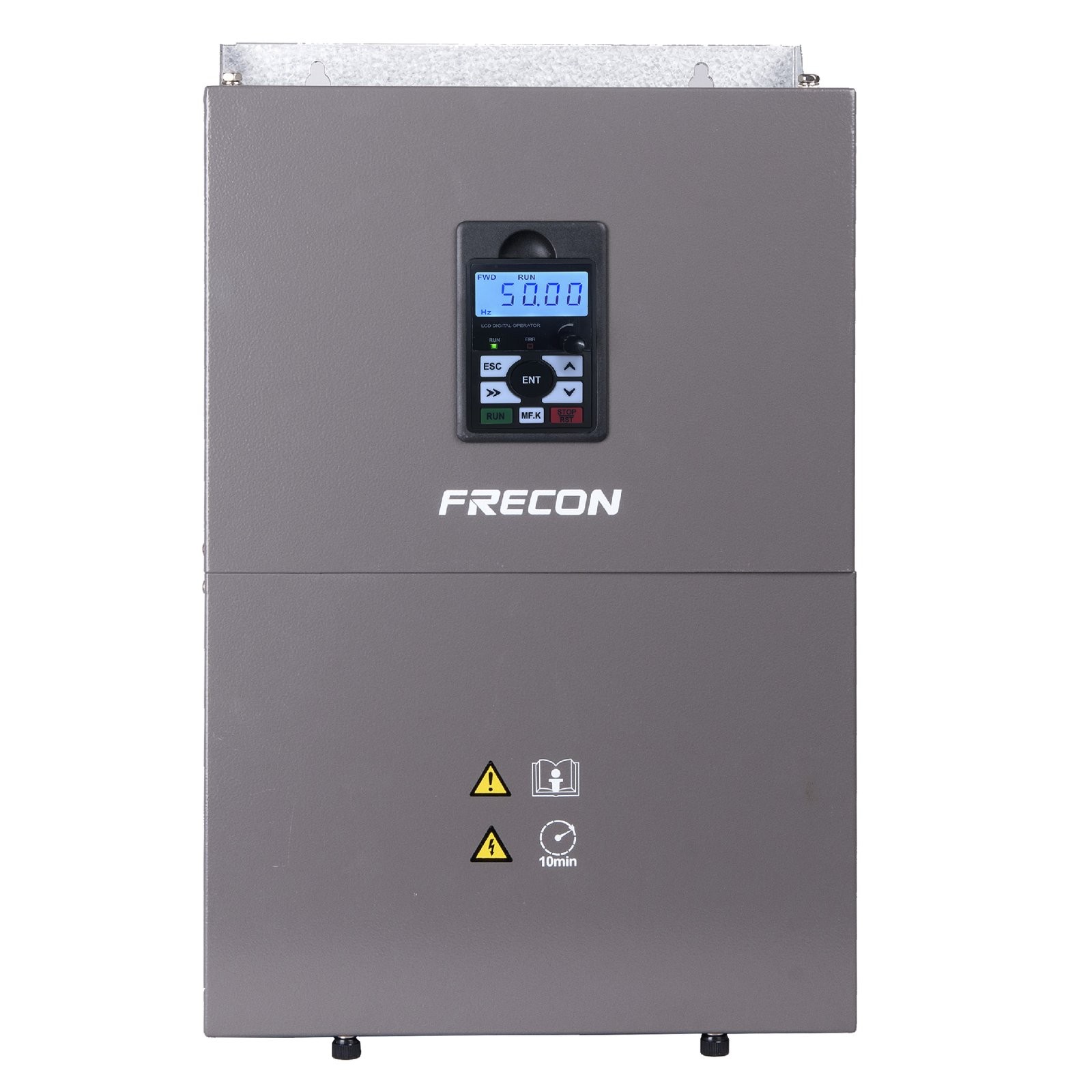
Long cable runs to a distant borehole pump can be fitted with an optional output reactor. On the operator side, the PV150A uses the same multifunction LCD keypad as the PV500, with a four-parameter display, built-in parameter definitions, and backup plus upload and download of settings.
Tank-level control prevents overflow and dry-run protection prevents damage when the well is drawn down, which lets the system run unattended as one of the more complete solar inverter solutions available for small and medium pumps. Both functions depend on correctly placed sensors, with a level switch in the tank and, where used, a water-level signal at the source.
Monitoring and a Practical Configuration Order
Remote access rounds off the configuration. Every PV150A model can take a 4G or WiFi module for real-time monitoring and remote operation through an app and web interface, and operating time, water flow and accumulated energy generation are kept in the drive’s own records.
Typical applications include agricultural irrigation, livestock watering, drinking-water supply and industrial water systems, and solar inverter solutions for each differ mainly in whether daily volume or continuity of supply comes first.
The configuration sequence runs from water to panels: daily demand and head define the pump, the pump nameplate defines the drive, and the drive’s voltage window and current limit define the strings. A solar MPPT inverter configured in that order works close to its design point from the first day, and FRECON’s published ratings give each step a concrete reference.
